
How Automated Contracts Reduce Dispute Risks for Builders
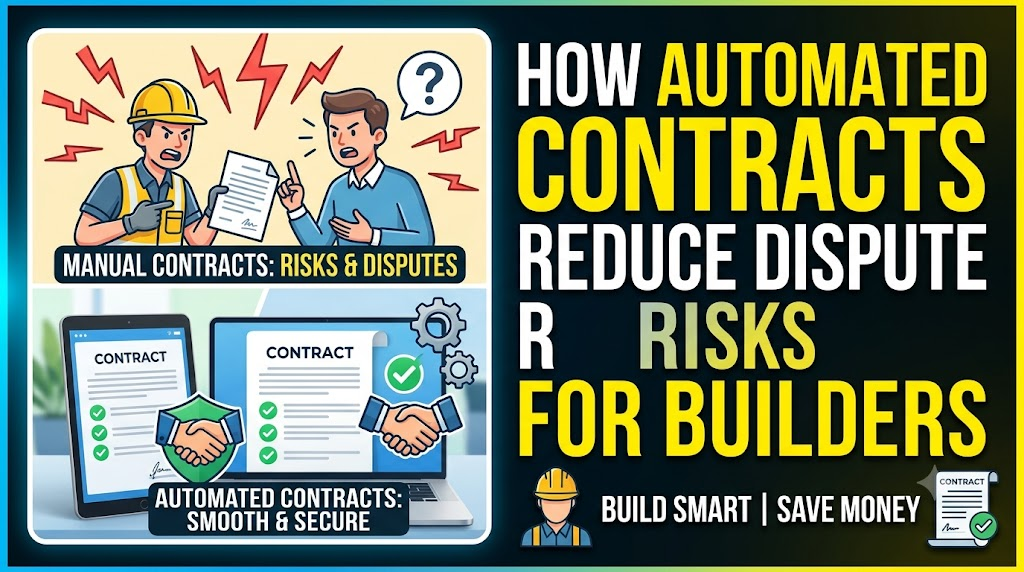
Construction projects have numerous elements, including materials, subcontractors, time schedules, payments, and many others. It is no surprise that the industry deals with a significant number of disputes. One of the leading causes is a complex system of contracts that have to be drawn up, reviewed, and followed during the realisation of projects. The use of automated contracts has made it possible to standardise many stages of the work, ensure transparency, and reduce the number of disagreements and misunderstandings.
Creating Greater Contract Consistency
One of the main benefits of automated contracts is that it allows for standardisation. Builders may work for numerous subcontractors, suppliers, consultants and clients, each with their own particular requirements. Preparing contracts for each of these can be time-consuming and could result in the omission of important clauses.
This does not eliminate the need for professional legal review. In complex construction arrangements, businesses may still benefit from advice from building lawyers Sydney when developing templates, reviewing unusual clauses or dealing with significant contractual risks. Automation works best when it supports sound legal processes rather than attempting to replace them.
Making Responsibilities Clear
We can think of some real-world dispute resolution scenarios where this technology could very well help. If a client and a contractor fail to reach an accord because the parties hold conflicting expectations of their obligations in one another in a contract, that may lead to some serious litigation. This could be due to an agreement for who must complete which tasks at certain points of a process, what tasks are due by specific dates or what is required if particular events occur,
This could also be helpful in the identification of important contractual terms, due dates, requirements of approvals and when payments must be received. In an environment where various agreements take place, this information’s location should be more quickly and easily found by project managers rather than digging through file cabinets or looking for the conversation within a series of emails.
Reducing Documentation Errors
Administrative errors can seem harmless, but they often play a critical role in a dispute. Missed dates, forgotten attachments, conflicting payment details or unsigned clauses can muddy the waters of an agreement and confuse the expectations of both sides.
Contract automation tools can enforce mandatory fields, approval hierarchies and electronic signatures to add clarity and control throughout the agreement lifecycle. A reliable digital audit trail is another key feature to consider. Based on the tools used, it may be possible to track who created, viewed, edited or approved a document at any point in its history – valuable metadata to have in the event of a disagreement.
Improving Change Management
Changes are quite common in construction projects as clients can ask for additions, materials’ prices can increase, or some unexpected challenges on-site may take place, among other reasons. However, if changes are approved informally, the problems can occur as different parties might have disputes over costs, responsibilities, and deadlines.
The application of automated contract systems can solve this issue by establishing certain procedures for varying any aspect of a contract. First, a proposed change can be made and reviewed by the relevant parties. Second, a change can be formally approved and become part of the contract. Then, approval notices can be sent out to everyone related to the contract.
Supporting Payment Transparency
Payment disputes represent a further point of contention, where builders, subcontractors and suppliers require clarity around invoicing requirements and milestones, and outstanding amounts. Automated contracts can be applied to manage the connection between payment terms and reminders, and the processes that apply.
Increased transparency reduces the risk of misunderstandings and encourages the necessary administrative action, and provides a clearer audit trail of responsibilities and obligations, useful if a dispute arises.
Providing Better Access to Contract Information
Construction workers, for example, frequently need to consult contracts while working outside the office, and searching through piles of paper or individual emails can waste time and lead to using an old version by mistake.
Centralized digital copies of contracts would be accessible to their users anywhere there is internet access. A team can check the relevant parts of a contract quickly before approving work, responding to a request, or communicating with subcontractors. Version control is crucial for distinguishing between the latest version and previous ones, especially when many changes occur during the course of a project.
Final Remarks
Automated contracts can give the builders more control over one of the most crucial aspects of their management than any other: the contracting process itself. By simplifying the documents, ironing out responsibilities, streamlining change control, and generally enabling better record-keeping, automating the process can eliminate many of the causes of contractor disputes.


