
How Artificial Intelligence Is Transforming the Future of Video Games
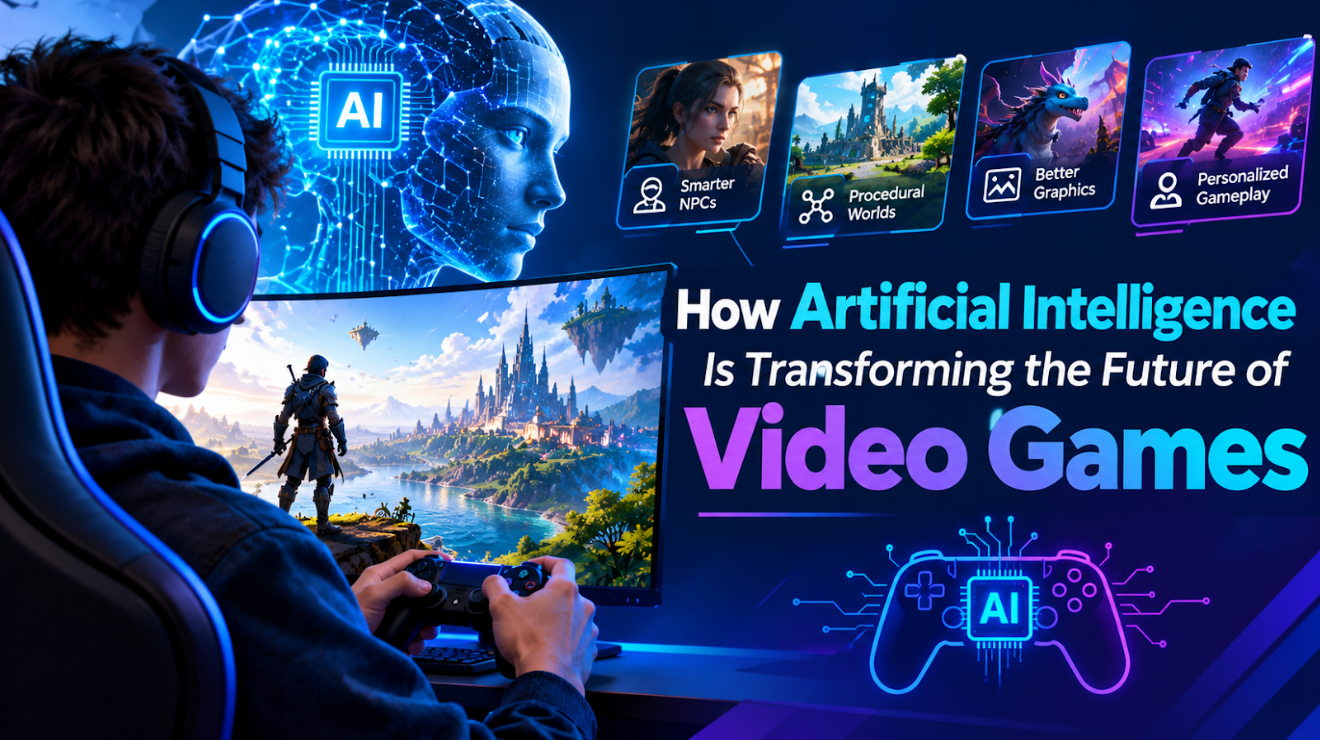
I do remember the first time an NPC in a game did surprise me. Not because the writers made some fancy story arc for him to respond to the players choices or the players hesitation before engaging in combat, but because the character appeared to respond to me, my play style, my hesitation and my choices. This was a pivotal moment for me, and it contributed to my fascination with the speculations surrounding how AI is changing the game from within over the past few months. Once again: Spoiler, it’s not only about smarter enemies.
Transitioning from a scripted behaviour to a genuine adaptation
For years, a game’s capabilities for Artificial Intelligence were simply a confusing set of tricks. The idea of enemies moving along canned paths, boss attack patterns that needed to be memorized, and the ‘difficulty’ that often meant providing more health bars to enemies all meant that everything had been mechanized. TOO, it worked, it was just choreography and not intelligence.
That’s changing fast. These days, Advanced machine learning models could enable execution of games that real characters can actually learn on the fly. An AI opponent can get into a variety of different ways, counter your tactics, change strategy with the fight, and more, instead of the standard one or two, you have the ability to bend their will to your own agenda. I’ve chatted with indie developers working on implementing light brain NNs in such a way as to not fall into the “predictable pattern” of what’s been happening with games for years. It’s not as if you’re fighting words, it’s like you’re fighting the words of someone who’s listening.
We’re adding creativity to procedural generation
Procedural generation is nothing new; they’ve always used algorithms to generate different levels, maps, and loot in the games. The difference with that generation is that they’ve got a lot smarter. Now, AI models can produce full environments that seem more intentional than random, as they are based on design principles such as pacing, difficulty curve, and visual composition, rather than being just random.
It’s particularly important for the smaller studios. It wasn’t that long ago when it was required to take armies of level designers and artists if their action was to create a wide open universe. Today, AI tools can even come up with a crude terrain map, add believable buildings and parts of the environment, and even suggest locations for player quests from player data. Not replacing designers— anyone who’s used these tools will tell you that it’s still weeks that take a human touch—but it’s coming in handy when having to speed up timeframes that were once measured in months.
NPCs can be smarter to create more believable worlds
One of the most discussed applications that are currently in great demand is dialogue and behavior systems for NPCs with AI. Some studios have started to get creative with language models which enable NPCs to actually hold conversation, often remembering what they have said in previous encounters and responding to context.
It’s both the area I am most excited about and the area I am most wary about, and I am not being disingenuous here. It can provide life to a game world in a scripted dialogue manner never before, when it is done well. If executed poorly, this can be as devastating as the other part, particularly when an NPC spits off something that runs counter to that of the game. There is technology available, but there are still a lot of people who don’t have the creative skills behind it.
Individualizes Difficulty and Player Retention
Player retention is the key to every games success, and AI is subtly gaining ground as one of the most effective methods of retaining players. While not a novel idea, dynamic difficulty adjusting has been made much more accurate with AI. Traditional “you died three times, here’s easier enemies!” has been replaced with dozens of signals to adjust difficulty dynamically, such as player reaction time and decision-making patterns, even the amount of time a player takes to respond.
This goes beyond combat as well. For instance, youtube comment picker recommenders within video games are beginning to recommend quests, equipment builds, or even video games based upon player take. It’s a gradual evolution, but it’s definitely impacting the way developers consider engaging — from a one-size-fits-all design to more of a custom experience.
Building the right AI for video games
Don’t take my word for it, it’s not just the player sides of games getting changed. AI is transforming the game development process behind the scenes. By leveraging AI image generation, concept artists can experiment with diverse styles and cut down on the time and resources needed to create prototypes before settling on a vibe.With AI-driven image generation tools, artists can quickly prototype some visual styles without getting locked into one without committing to a direction. Writers comment finder guides are using language models to generate branching dialogue trees which by themselves are very time consuming. QA teams are beginning to use AI bots that can play test a game thousands of times quicker than a human can, which will identify bugs and balance problems that may go otherwise unnoticed.
But it doesn’t mean human creativity is going away or that the tedious 80% of production is being taken over by the computer, it’s just that these people who are developing these ideas describe it as them letting the computer do a lot of the things they find boring and they’ve got more time to work on the things they consider to be art, which is the 20%. The 20% that has the human touch: tone, emotional beats, and human design intuition that no model has yet.
The advent of AI-generated voice and motion
Traditional animation—whether voice or motion capture—is an expensive and labor-intensive aspect of gaming, and was a rocky element for smaller studios. AI is helping to reduce that threshold. It is now possible to generate convincing character dialogue for use in placeholder testing, localization, or even final release in a few indies games. Likewise, AI-driven motion capture can interpolate animation from only a small number of joints, thereby reducing the need for extensive mocap sessions.
Of course this is the double-edged sword. It is letting small crews in to compete with large studios in both ROI and audio, but it’s also questioning in the industry the ROI and consent for voice actors who may be performing for these same robots.
Where This Is Headed
But if there was one thing that uniformly stands out from all this, it is that games are on the brink of multiple shifts, all of which are AI related and taking place at the same time. We’re going towards the games becoming more responsive, more customized, more “moldable” in some ways and less prescriptive, the worlds becoming less prescriptive and more responsive, often react to our own individual play, and the process of creating becoming more responsive and allowing small development teams to punch above their weight class.
I believe we are not even close to games being written and AI taking the place of creating a memorable game. This hasn’t changed radically; more drastically, however, the toolset developers have at their disposal. And the games which will roll out in the next few years will all be subtly different in ways we probably won’t be able to tell within the game’s fares, but just “a little more, right this time.


